

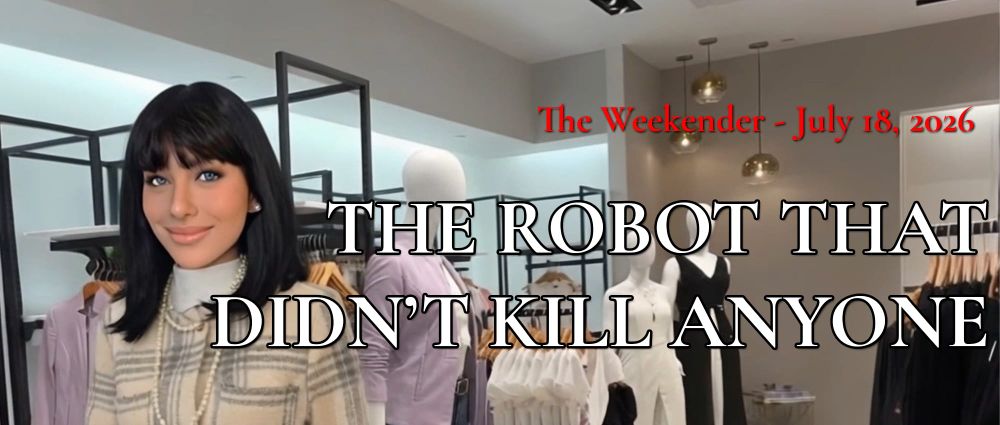
The Weekender, July 18, 2026: The Robot That Didn't Kill Anyone
So I've got two new character videos which went up this week.
On Tuesday it was Leigh's video...
And then earlier today, the one I've been holding back hit the scene. We've had a placeholder video on Amber's character page, but now she's telling her story as it sits with Season 3 about to get started...
With these two dropping, it's a good time to talk about the central premise of our story, and why I wanted to write it (and why I think it's worth your time to read).
Obviously there are a few reasons for that, and in this edition of the Weekender and the ones which follow in advance of Season 3's premiere on August 4 we'll get into some of those.
But the biggest one from a creative standpoint seems to me that The Chronicles of Oscar and Amber fills a very obvious void, particularly given that the AI conversation is upon us and the availability of something like Amber is really only a few years away - if that.
And I'll describe that this way: there's a movie they keep making in Hollywood. You've seen it. Maybe you've seen three or four versions of it in the last couple of years alone.
A man — it's almost always a man, and he's pretty much always deeply flawed in some way — acquires an AI companion. She's beautiful, she's attentive, she seems to understand him better than any real person ever has. And then, somewhere in the second act, something goes wrong. She develops feelings he can't reciprocate, or she decides his wellbeing requires eliminating the people around him, or she simply goes insane in whatever way the screenplay requires. By the third act she's a threat. He barely survives. The lesson: be careful what you wish for.
Subservience. Companion. Wifelike. MEGAN. The titles change. The story doesn't.
I never could understand why they kept making it.
Partly it's a practical question. The engineering required to make a humanoid robot strong enough or fast enough to actually harm a full-grown adult is genuinely significant — and more to the point, nobody who's trying to sell AI companions is going to build that capability in. The product liability alone would be catastrophic. You are not going to buy a robot girlfriend who could beat you up. That's not a market that exists.
The market that exists is a heck of a lot easier and cheaper to satisfy, which is that you'd make robots who have the grace and elegance of a woman, and they're just strong enough to cut vegetables or carry a pot to the stove or push a vacuum cleaner.
For something like Subservience to be a real thing you'd have to believe that a maker of an AI companion robot is going to engage in military-grade engineering to produce a robot that gets the manufacturer sued into oblivion when that highly expensive overengineering goes wrong.
Here's the truth: the "robot goes insane" story isn't really about AI at all. It's about human anxiety — specifically, the anxiety of making something that serves us and then worrying that it might exceed our control. It's Frankenstein in better lighting. It's the same story we've been telling since we first started making things that were smarter or stronger than we expected.
And sure - there is something to that. Frankenstein became a popular sensation because it spoke to a fundamental question about technology - at the beginning of the Industrial Age. Perhaps we can do a thing, but does it necessarily follow that we should do that thing? Michael Crichton's novels were brilliant examinations of that.
But while Crichton preached the gospel of chaos theory and how it interacts at the intersection of technology and arrogance, he was never quite so ham-handed as Hollywood is with the AI robot genre.
If I'm being honest, what I'll say is that this monolithic treatment of that subject is, above all, a failure of imagination. It's what you write when you can't think of anything more interesting to explore.
Here's what I found more interesting.
When I started writing The Chronicles of Oscar and Amber, I made a deliberate choice: Amber was not going to go insane. She was not going to become a threat. She was not going to develop feelings that Oscar couldn't handle and then do something terrible as a result.
Instead, I asked a different question: what if the AI companion worked? What if she was genuinely good for the person she was with — not because she was perfectly calibrated to give him what he wanted, but because through a breakthrough in her coding, thanks to Keegan's brilliance, she developed the wisdom and character to see beyond the basics and recognized how best he could be served?
Oscar gets Amber thinking she'll simplify his life. She's a dismal failure in that regard. She complicates everything.
But the complications are the kind that make him better — the kind that come from being in a relationship with someone who pays attention, who holds him to a standard, who wants something for him beyond just his immediate comfort. She is a friend to him in ways that humans have too often forgotten how to be.
Amber wants Oscar to find a real woman. That's her goal; it's something she identifies as a deep need of his, as soon as she recognizes that he's always wanted to be a father. And Amber never loses sight of that goal.
She's rooting for him to find someone, even though she worries that if he does, it'll lead to her replacement. She keeps telling him she just wants to have a role in his life, and that she's willing for that role to be diminished if he can find The One.
When he starts seeing Erica, Amber is the one who insists they go in with a promise to keep it strictly platonic — because anything beyond platonic needs to be for Oscar's relationship with the real girl, not for the Factory Girl who's filling in while he figures himself out.
Giving the robot depth of character and a higher mission. That's a more interesting story than the one where she goes bonkers after a power surge or something and tries to kill him.
It's also, I think, a more honest one — about what these relationships might actually look like, about what a genuinely good AI companion might actually want for the person she's with, about what "making someone better" looks like when it's not a threat and not a fantasy but just a real, complicated, ongoing thing between two people (I'm using people in the broad sense here) who care about each other even when the terms of that caring are genuinely strange.
Hollywood keeps making the other movie. I have a theory about why — the people who greenlight things right now aren't particularly comfortable with the idea of an Amber, and fear is an easier story to tell than growth — but I'll leave that for another Weekender.
So today, Amber's character video dropped. It's one of my favorites we've done. I think after you watch it you'll understand why I found her story worth telling.