
The Weekender, October 4, 2026: When The Ambers Come
Those of you who are reading the Oscar and Amber story understand that it's at least a little bit prophetic, right?
One reason there are so many people out there hopping mad about AI is that people know the robots are coming. Our story here is painting that eventuality as funny and chaotic and only optionally central to the larger narrative - you could really just see Amber as an auxiliary to Oscar's story, seeing as though he's having a late career bloom and seeing an upward arc of his romantic prospects. Compared to that, Amber's story isn't all that compelling.
Except for the novelty she presents.
And that's what's almost certain to come, and it might very well look like the O&A story when it does.
But there's a lot I'm leaving out, because when the robots come it's going to be a little fuller picture.
What do I mean by that? Consider this scenario.
You've undoubtedly seen these stories talking about how more men are single than ever before - and of course that's true of women, though young women will just marry older men, for lots of reasons - while technology advances toward an Amber becoming possible leads one to a pretty strong conclusion.
Within 10 years or so, consider, most households above the median will drop $1000 or $2000 per month on a lease or a mortgage for an AI companion robot. The reasons for having one go far beyond sex, which is the thing everybody talks about. But the robots, when they're fully brought to market, are going to cook and clean, they'll serve as personal secretaries, they'll help find your keys when you lose them, they'll walk the dog when you don't have time, they'll fix things which are broken, at least some of the time, and they'll keep you company when nobody else is around.
That's not a small thing, by the way.
Everybody who can afford it is going to get a companion robot. Every household will have one. And particularly single-people households.
All of these men who have given up on women are not broke guys. A lot of them are well-established and divorced or never-married. They could easily afford the lease or mortgage on a 50-75k companion robot, and if they're going to spend the money on a housekeeper or a personal assistant, why not get the robot to be a bedtime companion as well?
Women won't adopt as early, but ultimately they will.
In the story I do a little bit of development of the infrastructure around Factory Girls and how they operate, specifically with the need to take their heads off their bodies so they get a "reset," which essentially is like clearing the cache on your laptop or shutting it down for a while and rebooting, and with the file sifting of the upload-download procedure so that the computer memory in the AI companion robots' brains don't get overloaded.
I'm assuming that's going to be an issue if the robots are built to retain things they see and hear. I'm including smells and feels as well, though that might not be part of the first batches of robots to market. How to handle all that data is a major issue. Of course, it plays into the necessity for data centers.
In O&A-world, how the sex/companion robot thing works is it's a robot sex doll with an AI-powered neural network brain, though interestingly part of a Factory Girl's character/personality comes from the body that head is mounted on. Or, more specifically, perhaps, it's the interaction between the head and the body which produces that variance. Amber undergoes some changes as she moves from her first body to her second body, and she absolutely notices a difference when she borrows Katie's body. In Season 4 when she gets a new, taller body (yes, that's a spoiler for you), she'll have another evolution.
Which is all very cool, but the other piece to this is the upload-download plot device. The Factory Girls have to undergo file sifting so they don't get a memory overload from the accumulation of sights, sounds, smells, feelings and thoughts they've generated. Every few days they have to upload all of that to a server and then download the important things from that data - sort of like long-term memory and short-term memory.
And Oscar and Keegan start a little business to displace this function from Z Company, the manufacturer in China, on the theory that it was being abused by the Chinese for two purposes - espionage and commercialism; i.e., your Factory Girl does her upload-download and all of a sudden she desperately wants to shop at Temu.
But the ultimate data question, to me, seems obvious: every house is going to have a little server farm in a closet somewhere, which keeps the data for the household robots - the Roomba, the sprinkler system, the home security system, the internet-of-things appliances, and the Amber - so that data isn't on a cloud where it can be hacked or extracted. People will demand privacy, and when AI advances to the point where it becomes diffuse and everyone has their own household AI engine customized to them rather than depending on large corporate models, they're going to want that AI sitting on a local machine.
So you won't have Oscar and Keegan running an upload-download service, you'll have Oscar and Keegan customizing your individual home data center so that your Factory Girl and other AI assets can run independently of the cloud.
But when this starts to become a ubiquitous thing, what does that look like? Do the robots just replace family formation and we die out as a species?
There are two scenarios.
First, there's the one this story presents. Amber is, at least aspirationally, an asset for Oscar to find somebody. She's committed to helping, though toward the end of Season 3 that hasn't borne fruit yet.
And Oscar might need her for it. Not just Oscar, by the way - in real life, everybody says meeting people is hard as hell.
Why? Because they're on dating apps. And dating apps are brutal.
What's wrong with them? Well, think about it: how much do those apps really want you to find The One?
When you land a long-term relationship you're going to cancel your subscription. That's where their incentive structure leads you: nowhere. They want you to fail at dating. So those apps are built for browsing, not matching, and the proof of that is that dating apps are now built on swiping left or right based on glamour pics people post, not whether you'd actually have a connection with these people you're judging in half a second.
Relationships aren't formed that way. The dating apps are an absolute disaster. They're far worse than singles bars ever were. At least people in singles bars would get desperate at closing time and give somebody a chance. It was sad and pathetic but those were at least connections and there was communication, no matter how unsatisfying.
This? Utterly hopeless for the majority of people stuck using it to find a mate. Considered a little different way, that is what a cloud-based companionship system - all these people being on an app optimized for keeping them around so the app can drain their bank accounts once a month - delivers.
Now - consider what happens when everybody has a robot personal assistant and a little server farm in a closet of their house.
If the devices in your household - your phone, your computer, your robot - are no longer plugged into the internet 24/7 because you're no longer using Claude or ChatGPT to power all your research and data functions but instead you have a household data center-based personalized AI engine which is wedded to you and dependent on you for inputs, commands, etc., things change a bit.
Your AI - your personal Claude or Grok or Copilot or Gemini; that's what's coming when the technology broadens and it isn't based on what these "frontier" AI companies offer - will be YOURS, and it will firewall your data against the internet, because it can; your house will be able to store more than enough information without riding on the internet all day.
And that AI will know everything about you and it'll be invested in your happiness. So don't be surprised when it then begins to interact, prospect and vet potential romantic partners on your behalf.
Wait - am I saying that your AI companion robot will become your personal yenta? Yeah, maybe so.
Now, lots of people will insist on doing this themselves, because they enjoy the game. But the people buying companion robots, male and female, and are the early adopters, will be the ones who don't enjoy the game and are burned by it and will want help in curating their romantic involvement. The AI will be the one doing the stupid swipe-left, swipe-right stuff based on your interactions with it and it'll also be the one going deeper to find people with whom you can make a real connection.
The swiping was an evil genius idea by the dating apps. It reduced attraction to essentially a photo with an AI filter, and people are selecting based on utterly stupid criteria.
Most people don't decide whether somebody is worthy of pursuing a relationship with until they get to know them a little - went to school with them, worked with them, church, mutual friends, etc. The swiping eliminates all of that. It's no surprise it doesn't work, and it has also, specifically with women, encouraged this instinct to immediately judge whether you're attracted to somebody within a few seconds. That was never true before.
Well, if we don't get the big cultural changes we're going to need in the world that's coming, AI is going to have to help.
So your household AI is going to take a packet of information that you agree to let out of the firewall and it'll share that data with some service which is going to match it with that of some other household AI, and by the time you've met somebody your AI and theirs will have worked out a mutual dossier that's pretty damned accurate. "Here’s what Todd and Mary's relationship is likely to look like. Todd, you interested?"
That's a more complicated version of Amber deciding to be Oscar's wingman. But it's entirely likely that will be part of the AI companion robot story.
Now, the second scenario - the ugly one - is at least as likely, and it looks like this: if the single men all get Ambers and the single women stick with wine friends, trips to Cabo, hookups, and vibrators, we never actually get to the counterparty AI scenario and to keep the species alive the government will start paying 18 year old girls 50k a pop to get pregnant as surrogate mom's for single guys who want to be dads, and then you end up with a whole bunch of Katies like in the story.
And there are problems with the AI counterparty system I'm proposing.
Here's one: Early adopters of household AI systems are going to be affluent, as I've noted. That means the AI matchmaking network initially only has rich people in it, which will skew everything — essentially this becomes a high-end matchmaking service dressed up as technology, and the people who most need help finding partners (less affluent, less socially connected) are the last ones to get access to it.
Also, the counterparty AI scenario assumes both household AIs are representing their owners accurately. But people will inevitably try to game it — feeding their AI a curated version of themselves to present to potential matches, which recreates the same fundamental dishonesty problem as dating app profiles, just one layer removed. When your AI becomes your PR agent instead of your honest representative, it's the dating apps all over again, only more elaborate. The only system that works is one where the AI is so deeply integrated with its owner that it can't be gamed — which brings us back to the local, embedded, long-term companion model rather than a service you can manipulate.
And embedded, long-term companions will make people very comfortable having them around. Meaning the urgency to find somebody drops off - and then are you even telling your AI yenta to hook you up anymore?
Maybe not.
That's the loneliness paradox, and it's the thing which has quietly rested under the surface of Oscar's story. He tells Amber he's never going to find somebody who can compete with her, which is quietly devastating even if he doesn't realize it.
The other part of all of this which deserves a mention is that the vetting I'm talking about, which the men might very well use their AI robots/household Claudes to do, because that's absolutely a dude thing, is likely to be popular with women as well. In fact, vetting is more or less an obsession for women in the dating world, so obviously they're going to do it.
But one of the trust breakdowns between modern men and modern women is reputational damage for very innocuous offenses. We've all seen the guys who've gotten utterly destroyed online for looking at the scantily-clad girls at the gym, or for making an awkward advance. Setting up a collaborative system using AI that vets men is going to get pushback from men.
Think about it: Women build vetting networks because they've been burned. Men refuse to engage with vetted systems because they've been falsely accused or know someone who has. Both responses are rational given their respective experiences. Neither response is wrong. And the result is two groups developing parallel, incompatible technological solutions to the same loneliness problem that make them less likely to find each other, not more. Meanwhile, there's a robot who'll be your best friend and give you what feels like love, and you don't have to risk getting your heart broken.
Which is actually the most prophetic thing Oscar and Amber is doing thematically — it's not really about AI companionship, it's about what happens when men and women stop being able to trust each other enough to take the risks that courtship requires. Amber isn't the story. Amber is what happens after the story of male-female trust has already ended.
I'd like to think that the market will drive AI to play a positive role in repairing that trust, and maybe the AI yentas are a way that can happen. But I don't know if that's our future.
I do know the robots will be in those households. That's coming. The impact they make, and how they interact with the other stuff we'll have, and how all of this combines to save human relationships - or destroy them - I can't predict.
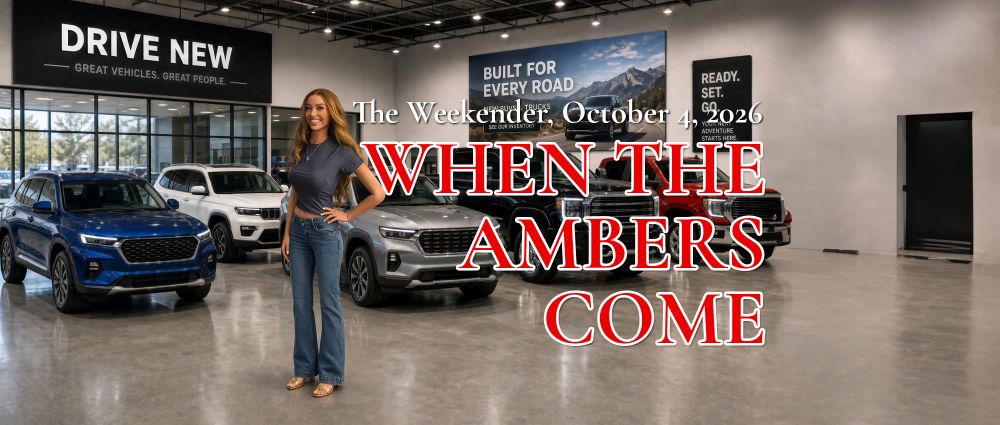
I know. All of this is pretty heavy stuff. So here's Amber, in a car dealer showroom, dancing to Earth, Wind and Fire.