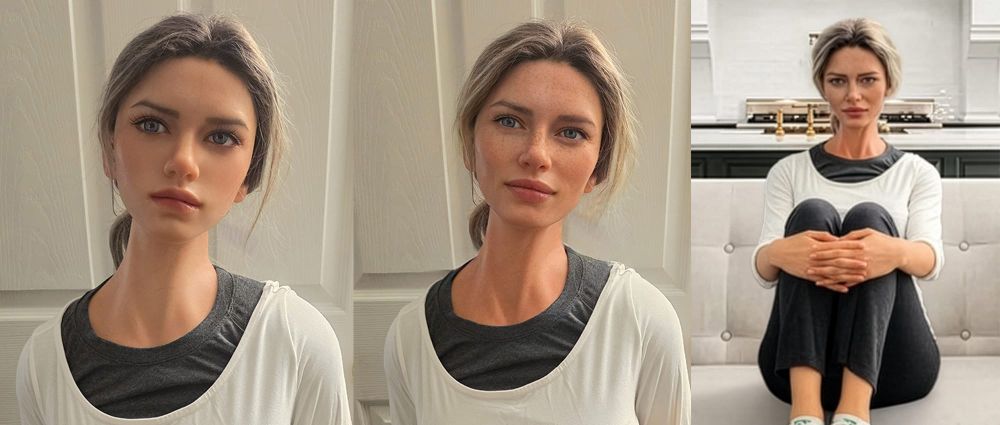
The Weekender, May 29, 2026: Hi There!
Hello from the new place.
If you're reading this, you found us — either from Instagram, or from Patreon, or from somewhere else entirely, and I'm genuinely glad you did. Welcome to the first Weekender, which is going to be a semi-regular dispatch from behind the scenes of The Chronicles of Oscar and Amber.
I'll write these when the day-job allows, which means they'll likely go out on Fridays or Saturdays. The Weekender is just going to be sort of a catch-all blog keeping our readers up to date on goings-on here at the site, answering questions you might have, sharing an idea or two, and so on.
We moved.
After a long run at Patreon, the story now lives here at OscarandAmber.com — all of it, free to read, no membership required for the story content which is up right now. Both seasons. All five bonus episodes. The six Perspectives short films. The character bio pages. All of it, right here.
If you've been meaning to start, now is the time. Season 1 is twenty episodes. Season 2 is twenty more. And Season 3 — all twenty episodes of it — debuts in early August.
That's the news. The outline is done. I'm writing scenes now. S3E1 drops at the beginning of August and if I do my job right, you're going to want to read it in one sitting.
How Erica came to life.
A lot of you have been asking about the character videos — specifically how I'm making them, because they don't look like anything else out there. So here's a peek behind the curtain.
I don't have an actress playing Erica. And she isn't an AI creation out of the ether. She's something different. And so you'll know, all of the female characters in the story originate similarly.
In the story she's fifty years old — a grandmother, a widow of an oil company CEO, a woman who has spent three decades being the most capable person in every room she walked into and has only recently started to make peace with that.
In real life she's a doll sitting in my studio. Specifically, she's a TopCyDoll model 176D with the Polly head. The challenge was making those two things the same person.
This is Erica as she appears in real life...
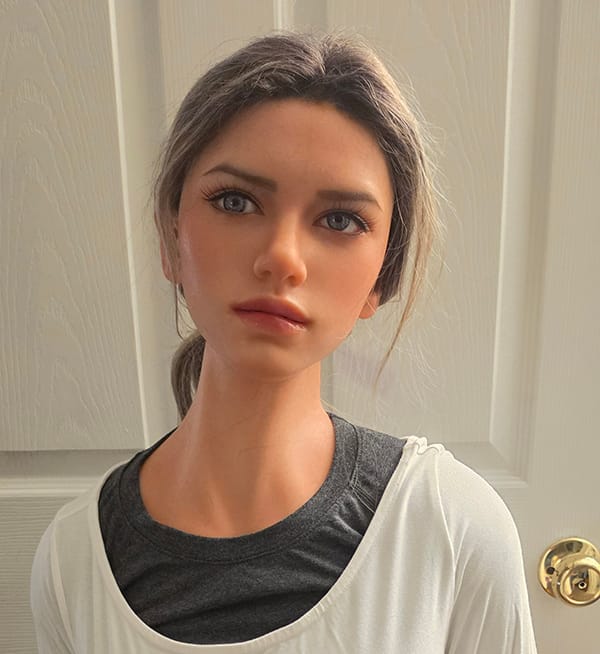
So how do I turn her into the woman you see in that Meet Erica video?
It starts in FaceApp, which is a mobile app pretty much everybody knows about. I age the base images, push the cheekbones, add freckles, bring in a fuller lip, dial back the makeup. Ten different angles, ten images, all processed the same way. What comes out the other side is a fifty-year-old woman who looks like she's lived something.
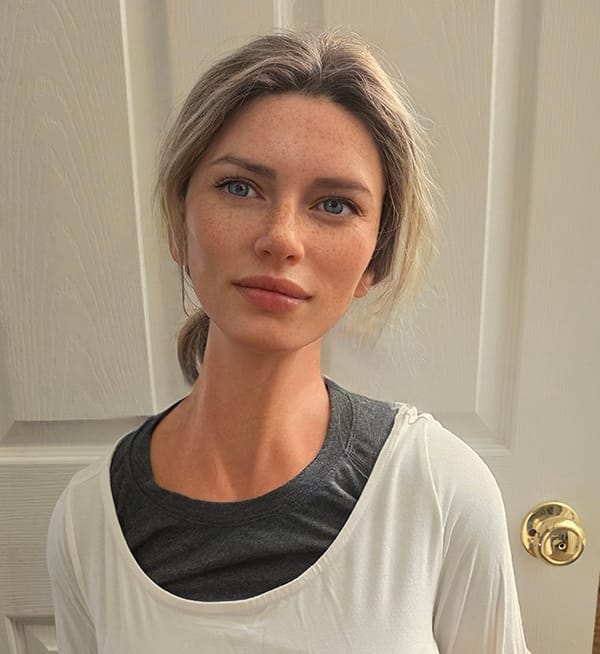
Then I take those altered FaceApp images into Magnific — which is my main portal for AI image and video work — and I build a character package. That package becomes the anchor for every image and every video clip in the film. Consistency is everything. If Erica looks like three different people across a 2:47 video, nobody is going to believe her.
From the character package I generate composite images — Erica on her actual couch in her actual living room, which doesn't exist but looks completely real. Some of those images need face corrections in Photoshop, which takes about ninety seconds per image once you've done it a few times. Some of them are perfect out of the box. I also run images through Higgsfield's Shots function, which takes one image and gives me nine alternatives from different angles and distances. A lot of my best stills come from there.
Once I have a dozen solid images, I go into ElevenLabs and record the audio. ElevenLabs v3 is remarkable — you can drop instructions right into the script in brackets, like [pause] or [sighs] or [furious], and the model responds. I've gotten emotional range out of it that I didn't think text-to-speech could deliver.
The motion clips — the moments where Erica shifts on the couch, or looks away, or raises her knees — come from Kling 3.0 through Magnific's video generator. I set a start frame and an end frame, prompt the motion, and Kling figures out how to get from one to the other. Most of those clips run five seconds or less. They're the punctuation between the dialogue.
The talking-head clips — Erica actually delivering her lines — come from HeyGen. You load a still image and an audio clip, hit generate, and HeyGen animates the face to match the voice. It's fast, it's cheap, and for a single character speaking directly to camera it's almost indistinguishable from real footage.
Then everything goes into Microsoft ClipChamp, gets arranged in order, and becomes a film.
Erica's video runs 2:47. It took me the better part of a day to make. I think it's the best thing I've produced so far. You can watch it at OscarandAmber.com/erica or on the YouTube channel. Or you can watch it right here...
One more thing.
If you want to go a little deeper into the story — early access to Season 3 episodes as they're written, bonus content, and the occasional dispatch that doesn't go out to the general list — that's what Amber's Army is for. It's $5.99 a month or $59.99 a year. No pressure, no hard sell. But if you're enjoying the story and you want to be part of something, the door is open.
See you next week.
— O.